Our Vision
Working with local Councillors, wildlife groups and landowners, with the help of Sir John Lawton, author of the 2010 government review of England’s protected areas “Making Space for Nature”, we have been developing a project to reconnect the Ancient Woodland from Kings Wood and Perry Wood, North-Eastward to the Blean Woodland Nature Reserve and East Blean at Hoath, to connect essential wildlife habitats and re-create a landscape-scale Forest in East Kent.
This exciting project includes a “Green” land bridge across the A2, creating “stepping stones” to connect habitats and developing marginal habitats to support the biodiversity of the forest.
As part of this scheme, we will be proposing an expansion of the Kent Downs National Landscape, (previously the Area of Outstanding Natural Beauty) into the area, to create a substantial forest that can support threatened species and, possibly, allow the reintroduction of larger, lost species such as Bison and Lynx.
Our Objectives

Work in partnership with the relevant Local Authorities to advance their Local Nature Recovery Plans and other biodiversity targets;

Work in partnership with existing nature & wildlife organisations to enhance, expand and connect priority habitats on a landscape-scale;

Work in partnership with the local farming and landowning community to generate sustainable farming systems in and around the proposal area;

Enable more people, and more diverse audiences, to discover, explore, enjoy and understand the ancient forest and connective “stepping stone” and marginal habitats; how they are managed and the wider benefits they provide;

Work with Natural England to create an expanded Kent Downs National Landscape area that includes The Blean.
Making Space for Nature
In 2010 Sir John Lawton carried out an official review of England’s protected areas, published as Making Space for Nature, challenging the Government to address the loss of biodiversity and providing guidance on how everyone, from farmers, wildlife groups, landowners and individuals can play a role in helping to create, manage and improve these areas.
The Report states that:
“Surviving in small, isolated sites is … difficult for many species, and often impossible in the longer term, because they rarely contain the level of resources or the diversity of habitats needed to support sustainable populations… However, re-creating large expanses of continuous natural habitat is not a feasible option over most of England. An alternative approach is to secure a suite of high-quality sites which collectively contain the range and area of habitats that species require and ensure that ecological connections exist to allow species, or at least their genes, to move between them. It is this network of core sites connected by buffer zones, wildlife corridors and smaller but still wildlife-rich sites that are important in their own right and can also act as ‘stepping stones’ … that we call an ecological network. ‘Wildlife corridors’ do not have to be continuous, physical connections: a mosaic of mixed land use, for example, may be all that is needed – it is the permeability of the landscape to species (or their genes) that matters”.
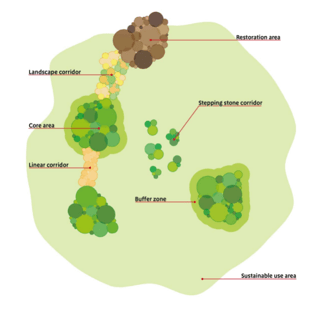
Stepping Stones” & “Corridors” create a sustainable ecological network
We will work in partnership with the local farming and landowning community to use government incentives and other grants to create marginal habitats and “stepping stones” within the project area.

