There are numerous sources of funding available to farmers & landowners for rewilding, tree-planting and biodiversity gain.
Kent Wildlife Trust have a Farmer Hub and useful Booklet on Managing Land
Kent Landholders Assisting Wildlife is a free-to-join members group building collective expertise on what funding is available, to whom it is available and when applying, how to increase the probability of the grant being awarded.
The Government Department for Environment, Food & Rural Affairs environmental land management (ELM) schemes include:
- Sustainable Farming Incentive
- Countryside Stewardship Higher Tier (CSHT)
- Capital Grants
Tailored guidance and support is available from Defra a Farming for the Future
The Farming Advice Service (FAS) provides free, confidential advice for farmers and land managers in England to help protect people, livestock and the environment. In partnership with Catchment Sensitive Farming. Funded by Defra.
The Forestry England Woodland Partnership Programme is a woodland creation scheme through which Forestry England lease your land, provide their expertise in creating and managing woodlands, and pay you a rent.
They also have various Tree and woodland grants and incentives available to landowners.
The Countryside Stewardship Mid Tier provides a range of options and capital items that together help landowners to deliver a broad range of environmental benefits.
Use this tool to search for Government funded actions and their supplements for eligible farmers, foresters and land managers in England.
Selling in the Biodiversity Net Gain market is another choice for land managers. It is a potential source of revenue and could fund nature recovery work on your land. You may, for instance, choose to generate and sell biodiversity units alongside farming, creating income from land that may otherwise be unsuitable for food production.
Other grants & schemes include:
Government Tree Planting Grants
Woodland Trust trees for farmers and landowners
Kent Downs Farming in Protected Landscapes funding
Woodland Trust MORE Woods & MORE Hedges
By creating new woodlands which meet the Woodland Carbon Code standard, landowners can access a new source of income – carbon units.
Treeapp is an organisation that connects UK businesses with landowners who are interested in planting native tree species
New Developments & Nutrient Neutrality:
In 2020, Natural England advised that any new housing must not result in additional nutrients (nitrogen or phosphorus) entering the River Stour catchment to ensure no adverse impact on Stodmarsh.
The nutrient loading from new housing developments is due to the nutrients contained in surface water runoff and the increase in wastewater flows to any of the Wastewater Treatment Works. A nutrient budget will be calculated by each local authority based on their local plans, to mitigate the effects of nutrients which could adversely affect important habitat sites.
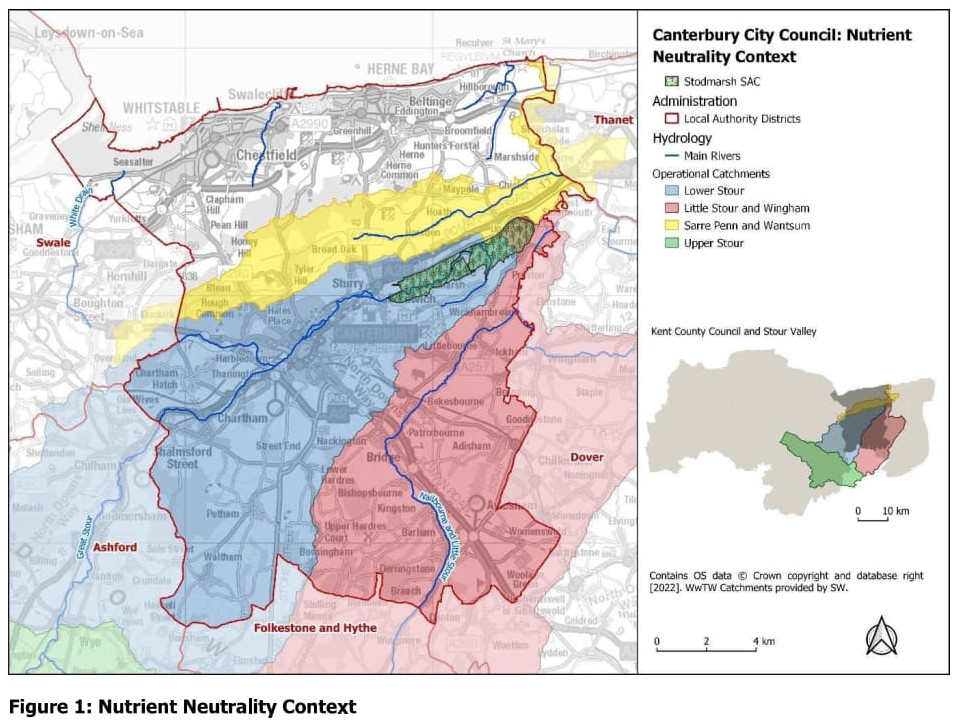
There is significant potential for local authorities to reduce nutrient loadings through changes in land use to wetlands and woodlands.
Woodlands have very low leaching rates, therefore any land use change to woodlands results in offsetting the nutrient load from surface water and can contribute towards offsetting a District nutrient budget.
A company is being set up to spend the £9.8m grant awarded to the Stour Valley catchment area by the government. Canterbury City Council are currently exploring options for creating and trading credits to unlock housing development across the area, they will be working with local landowners to help them create nutrient mitigation habitat, particularly wetlands and woodlands. These will be the basis for nutrient credits.
 Forest Of Kent