Our proposals provide a unique opportunity to support & enhance both National and Local landscape & biodiversity policies & guidance through the creation of a connected, accessible and well-maintained forest area. They will:

Support the ambitions of 30by30 by enhancing the Kent Downs National Landscape
Accord with The Environment Act 2021 by supporting Local Nature Recovery Strategies & extending the Kent Downs National Landscape
Support the Kent Local Nature Recovery Strategy by conserving & enhancing the woodland and connecting landscape
Support the Protected Landscapes Targets & Outcomes Framework by expanding the area of the Kent Downs National Landscape
Support the Swale, Canterbury & Ashford Landscape Character & Biodiversity Appraisals by conserving and enhancing the landscape and biodiversity of the proposal area.
Our proposals go beyond this by providing a unique opportunity to create a new landscape-scale forest area in a highly populated and developed part of the country. They will:
Follow the principles of “Making Space for Nature” by providing “Stepping stones” of ecological networks that can support existing species.
Enhance the existing Kent Downs National Landscape by improving connectivity and access through the expanded area.
Protect and enhance areas vital for habitat connectivity but currently not designated.
Enhance access and understanding of the forest area and the wildlife that live there through better connectivity and accessibility for the local community and visitors.
Create a connected forest area that could, in the future, support larger lost native species such as the Lynx, Pine Martin and Bison.
Our proposals provide a unique opportunity to support & enhance both National and Local policies & guidance through the creation of a connected, accessible and well-maintained forest area. The relevant National Policies
and guidance include:
Environmental Land Management System Agricultural Transition Plan 2021-2024
Local Nature Recovery Strategies
National Parks and Areas of Outstanding Natural Beauty Review
Protected Landscapes Targets & Outcomes Framework
The England Trees Action Plan 2021-2024
The Government’s 25 Year Environment Plan, A Green Future (2018), pledges that this will be the first generation to leave the environment in a better state than we found it and pass on to the next generation a natural environment protected and enhanced for the future.
The Environment Act 2021
The Environment Act 2021 sets out legally binding targets for the natural environment and establishes important legal requirements and mechanisms to enable the government’s goals for nature recovery. These include the:
- introduction of a new, England-wide system of local nature recovery strategies that will agree priorities and work with partners and stakeholders to map actions for nature recovery where they will have the greatest environmental benefit
- creation of duties and incentives for land managers, developers and local planning authorities to take action for nature recovery, including biodiversity net gain, protected site strategies, species conservation strategies and conservation covenants
- strengthening of the biodiversity duty on public bodies in the Natural Environment and Rural Communities Act
Making Space for Nature
In 2010 Sir John Lawton reported an official review of England’s protected areas, published as Making Space for Nature, challenging the Government to address the loss of biodiversity and providing guidance on how everyone, from farmers, wildlife groups, landowners and individuals can play a role in helping to create, manage and improve these areas. This report states that:
” Surviving in small, isolated sites is … difficult for many species, and often impossible in the longer term, because they rarely contain the level of resources or the diversity of habitats needed to support sustainable populations… However, re-creating large expanses of continuous natural habitat is not a feasible option over most of England. An alternative approach is to secure a suite of high-quality sites which collectively contain the range and area of habitats that species require and ensure that ecological connections exist to allow species, or at least their genes, to move between them. It is this network of core sites connected by buffer zones, wildlife corridors and smaller but still wildlife-rich sites that are important in their own right and can also act as ‘stepping stones’ … that we call an ecological network. ‘Wildlife corridors’ do not have to be continuous, physical connections: a mosaic of mixed land use, for example, may be all that is needed – it is the permeability of the landscape to species (or their genes) that matters”.
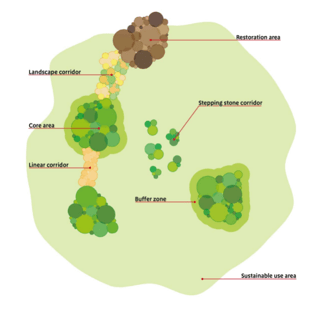
“Stepping Stones” & “Corridors” create a sustainable ecological network
30by30
The UK Government has committed to protect 30% of land and sea for nature by 2030 (30by30), to support the global 30by30 target agreed at the UN Biodiversity Summit (COP 15) in 2022. They recognize that achieving this target is critical to supporting the government’s wider priorities, including cleaner rivers, lakes and seas, boosting food security, and protecting communities from the dangers of flooding. They state that:
” Without nature there is no economy, no food, no health and no society. As the impacts of climate change grow, 30by30 will also support the nature-based solutions that will help us achieve our net zero target, such as peatland restoration, and will help to ensure that our natural environment is resilient and able to adapt. Our Protected Landscapes (National Parks, National Landscapes and the Broads) will provide the backbone to 30by30 in England, contributing towards the target where they are effectively managed and delivering in-situ conservation. This will be driven by the Protected Landscapes Targets and Outcomes Framework, as well as further action to ensure that these special places are wilder and greener. Through their management plans, existing structures and strong partnerships, Protected Landscapes organisations can also play a convening role to champion, identify and support areas that meet, or have potential to meet, the 30by30 criteria. It is important that Protected Landscapes deliver a significant contribution towards 30by30 in England. This is key to delivering landscape-scale nature conservation and realising our vision of a well-connected and ecologically representative 30by30 network”.

Protected Landscapes Targets & Outcomes Framework
Published in 2024, the Protected Landscape Targets & Outcomes Framework aims to demonstrate the vital role that Protected Landscapes play in tackling some of the most important challenges faced by society whilst continuing to support the rural economy and its rural communities. It will highlight opportunities for economic growth and investment and enable Protected Landscape bodies and their partners, including farmers and land managers, to mobilise green investment into natural capital. The Framework includes the following targets, particularly relevant to our proposals:
Target 1
Restore or create more than 250,000 hectares of a range of wildlife-rich habitats within Protected Landscapes, outside protected sites by 2042 (from a 2022 baseline).
Target 8
Increase tree canopy and woodland cover (combined) by 3% of total land area in Protected Landscapes by 2050 (from 2022 baseline).criteria. It is important that Protected Landscapes deliver a significant contribution towards 30by30 in England. This is key to delivering landscape-scale nature conservation and realising our vision of a well-connected and ecologically representative 30by30 network.
Environmental Improvement Plan 2023
In 2018 the Government Launched a landmark programme for Protected Landscapes. This includes proposals for new Protected Landscapes to safeguard more of England’s beautiful and iconic landscapes and actions to drive nature recovery. The Targets & Commitments outlined in the 2023 Environmental Improvement Plan include the commitment to:
- Increase the accessibility of green and blue spaces through the £14.5 million ‘Access for All’ programme.
- Invest in a new national landscapes partnership for National Parks, Areas of Outstanding Natural Beauty, and National Trails.
- Extend the delivery of our successful Farming in Protected Landscapes programme, using lessons learned to inform future farming schemes.
- Publish our ambitions for improving the quantity, quality and permanency of woodland access.
- Invest in active travel, with a vision for half of all journeys in towns and cities to be cycled or walked by 2030. £35 million funding has already been committed this financial year.
- Continue to progress assessments to designate two new Areas of Outstanding Natural Beauty (AONB) and two AONB extensions.
Local Wildlife & Biodiversity Policies & Guidance
Our proposals provide a unique opportunity to support & enhance both National and Local policies & guidance through the creation of a connected, accessible and well-maintained forest area. The relevant National Policies and guidance include:
- Canterbury City Council, Swale Borough Council & Ashford Borough Council Landscape & Biodiversity Appraisals
 Forest Of Kent